Across the federal government, one message is becoming clearer: major policy signals eventually translate into acquisition risk, pricing assumptions, enforcement posture, and execution expectations.
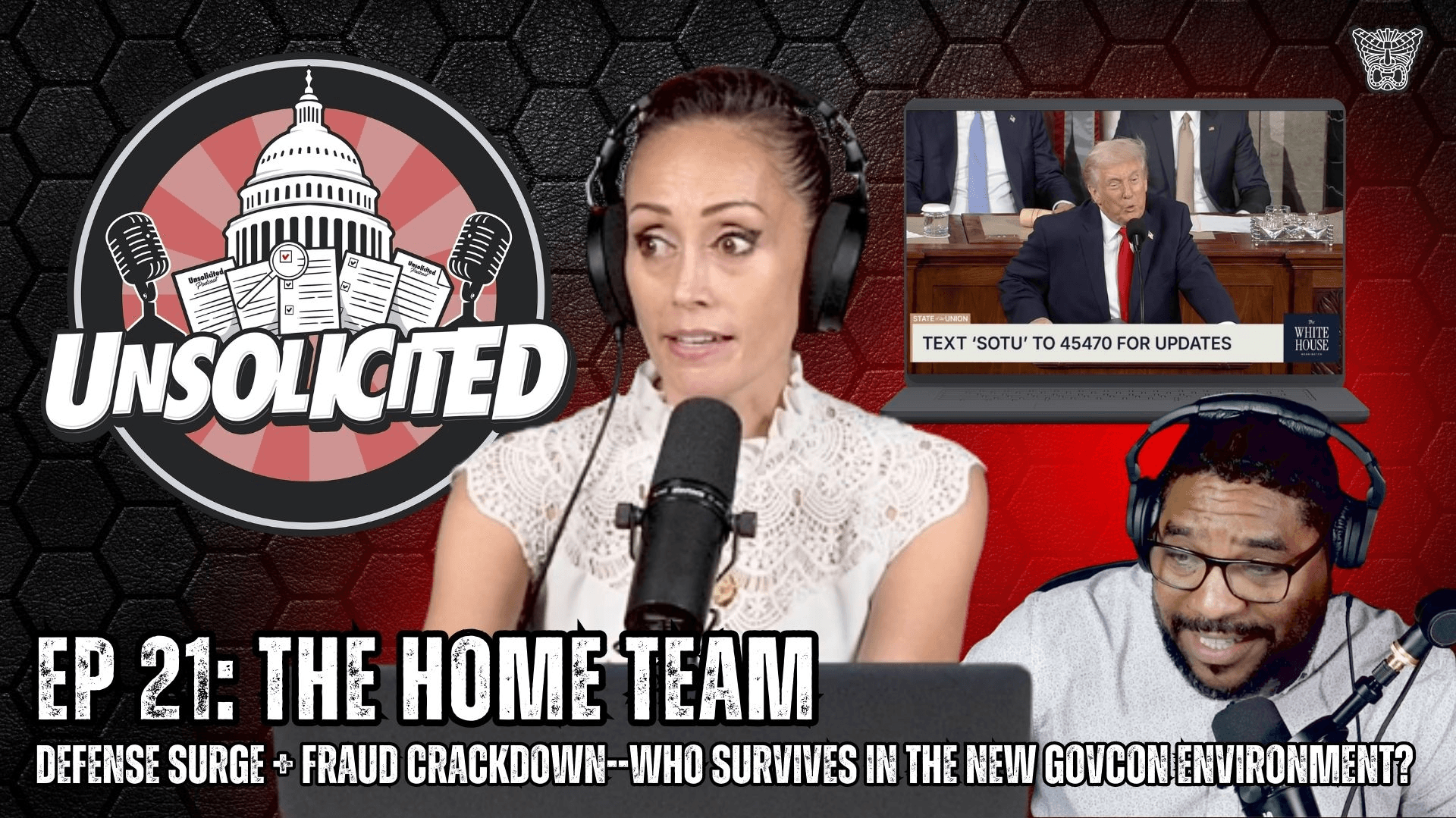
In this episode of Unsolicited, hosts Hope Skibitsky and Geronimo Moreno react to the February 25, 2026 State of the Union address, unpacking what the speech signals for federal contracting, defense spending, compliance oversight, AI infrastructure, tariffs, and international defense funding.
Rather than simply recap the address, this conversation examines the potential contracting implications behind the policy direction.
From the announcement of a “war on fraud” to a trillion-dollar defense budget, continued tariff authority, new expectations around AI data center power infrastructure, and expanded defense cooperation through NATO, the speech outlines a posture that could affect how federal contracts are competed, evaluated, priced, and audited.
Hope and Geronimo explore what these signals could mean in practice for contracting officers, acquisition professionals, and GovCon firms operating inside the federal system every day.
- If enforcement priorities increase, how should contractors strengthen internal controls and documentation?
- If tariffs introduce cost volatility, how should contracting officers evaluate “lowest bid” versus price realism?
- If defense spending expands, which contractors can scale responsibly without disrupting execution?
- And if AI infrastructure becomes energy-constrained, does power resilience become part of capability evaluation?
This conversation focuses on the practical question acquisition professionals are already asking themselves:
How do policy signals eventually translate into acquisition behavior?
What You’ll Learn:
- How a “war on fraud” enforcement posture could affect contractor oversight and audit exposure
- Why tariff volatility changes the way cost realism and pricing risk should be evaluated
- What a trillion-dollar defense budget could mean for workforce capacity and delivery strain
- How AI infrastructure and energy requirements may affect future cloud and data center procurements
- Why documentation discipline and operational maturity may become stronger differentiators in contract awards
- What acquisition professionals should monitor in the next 90 days
Sources & References:
- 2026 State of the Union Address
https://www.youtube.com/watch?v=8PQ7l905aVM
- DOJ False Claims Act Enforcement Data
https://www.justice.gov/opa/pr/false-claims-act-settlements-and-judgments-exceed-68b-fiscal-year-2025
- GAO Improper Payments and Oversight Reports
https://www.gao.gov/assets/gao-25-107552.pdf
- U.S. Energy Information Administration — Electricity Demand and Data Centers
https://www.eia.gov/todayinenergy/detail.php?id=62409
- U.S. Department of Energy — Data Center Electricity Demand Report
https://www.energy.gov/articles/doe-releases-new-report-evaluating-increase-electricity-demand-data-centers
- Defense Security Cooperation Agency — Foreign Military Sales
https://www.dsca.mil/press-media/major-arms-sales
- Congressional Budget Office — Defense Spending Analysis
https://www.cbo.gov/topics/defense-and-national-security
If you found this conversation valuable, we recommend:
▶ Episode 9: Jared Shepard (Hypori) — Secure mobility, infrastructure maturity, and scalable federal capability - https://youtu.be/JBSgL-guaGA
▶ Episode 3: Justin Lerma — Breaking down the Revolutionary FAR Overhaul and what it could mean for acquisition professionals - https://youtube.com/live/ymd6IoWsv8Y
If you haven’t already, like, subscribe, and turn on notifications on YouTube so you don’t miss future episodes of Unsolicited.
https://www.youtube.com/@NTI-GovCon
Follow us on LinkedIn
https://www.linkedin.com/company/namauu/
cd ../blog
EP 21: The Home Team - Defense Surge + Fraud Crackdown--Who Survives in the New GovCon Environment?
Alex Longoria-Mendoza
Podcast
Unsolicited
Real conversations about government contracting, no scripts, no fluff.