Execution in government contracting doesn’t usually fail because the work is impossible.
It fails because the environment isn’t understood.
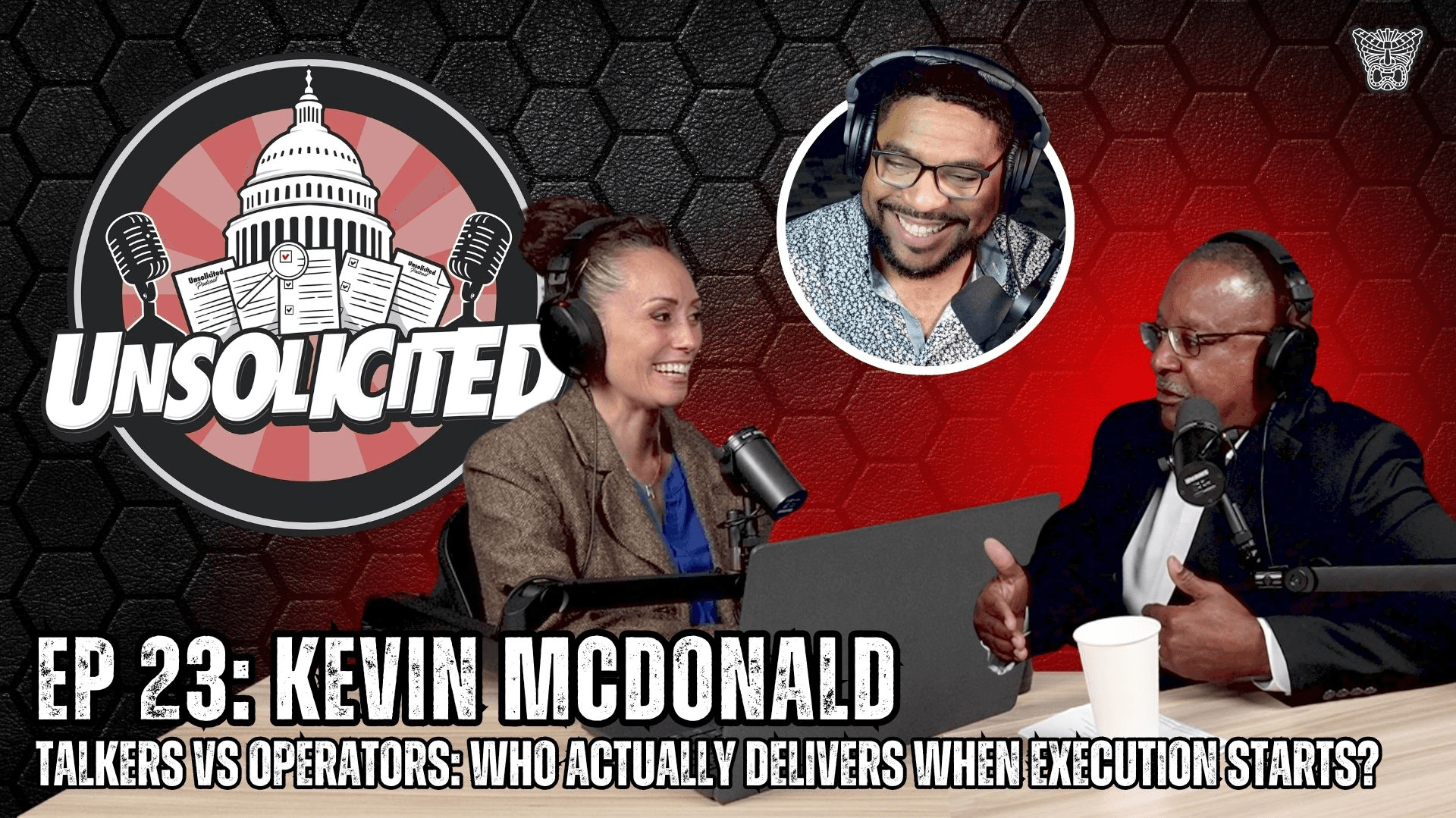
In this episode of Unsolicited, Hope Skibitsky sits down with Kevin McDonald of Core4ce to unpack a question that shows up across GovCon, usually after award:
Why does execution feel harder than it should — and how do you tell who actually knows how to run the environment?
From the start of the conversation, Kevin cuts straight to the root issue:
*“Lack of operational intelligence.”*
He breaks that down into four factors that consistently drive execution risk:
*information, resources, scheduling, and relationships* — and explains how gaps in any one of those areas can turn a clean contract into a chaotic reality.
This episode goes beyond general frustrations and gets specific about what actually happens during execution:
- Why transitions feel like “engineering vs archaeology” when documentation is missing
- How undocumented fixes and configuration changes create hidden risk
- Why contractors often walk into environments at an immediate disadvantage
- What really happens when systems stay up during a shutdown but authority, approvals, and support disappear
The conversation also tackles one of the most uncomfortable truths in GovCon:
- Confidence and competence are not the same thing.
- When environments start to wobble, Kevin explains why:
- Confident teams can sell capability
- Competent teams are the ones who actually deliver under pressure
That gap shows up in missed timelines, unclear explanations, stalled implementation, and teams that struggle to articulate what’s actually going wrong.
Kevin also walks through real examples where:
- Contracts were awarded before platforms were even funded
- Promised solutions weren’t approved for use
- Teams had to pivot from implementation straight into decommissioning
- Contractors operated at risk just to keep execution moving
These aren’t edge cases. They’re patterns.
The episode closes with what actually makes the difference between teams that struggle and teams that “just work”:
- Clear communication and defined requirements
- Operational discipline and documentation
- Transparency around risk and limitations
- A culture focused on solving problems, not just describing them
And a simple but often ignored principle:
You have to understand how the train is running before you try to change where it’s going.
What You’ll Learn:
- What “operational intelligence” actually means in execution
- Why risk often stays hidden until after award
- How poor documentation and transition gaps create long-term issues
- The difference between confident teams and competent ones
- Why statements of work often don’t reflect real environments
- Early warning signs that a team overpromised capability
- What to look for in partners if you want fewer surprises
About Our Guest
Kevin McDonald is the DHA Datacenter Operations Site Lead for the Medical Enterprise Systems Operation Center (MESOC) San Antonio, supporting the Defense Health Agency through Core4ce. He is responsible for maintaining mission-critical data center environments and ensuring systems are implemented, sustained, and decommissioned without disrupting operations.
Sources & Related Links
- Federal News Network – Federal Drive with Terry Gerton
https://federalnewsnetwork.com/contracting/2025/12/will-2026-be-the-year-govcon-shifts-from-disruption-to-execution/
- Government Accountability Office (GAO)
https://www.gao.gov/products/gao-25-107795
- FedScoop
https://fedscoop.com/agency-it-tech-operations-government-shutdown/
- Core4ce
https://www.core4ce.com/
Like, subscribe, and turn on notifications for more Unsolicited conversations about execution, risk, and how government contracting actually works.
Follow us on LinkedIn: https://www.linkedin.com/company/namauu/
Learn more: https://namauu.com/
cd ../blog
EP 23: Kevin McDonald – Talkers vs Operators: Who Actually Delivers When Execution Starts?
Alex Longoria-Mendoza

Podcast
Unsolicited
Real conversations about government contracting, no scripts, no fluff.