Quality in government contracting doesn’t usually fail at the end.
It fails much earlier, while the work is moving, while decisions are being made, and while people assume someone else is checking what needs to be checked.
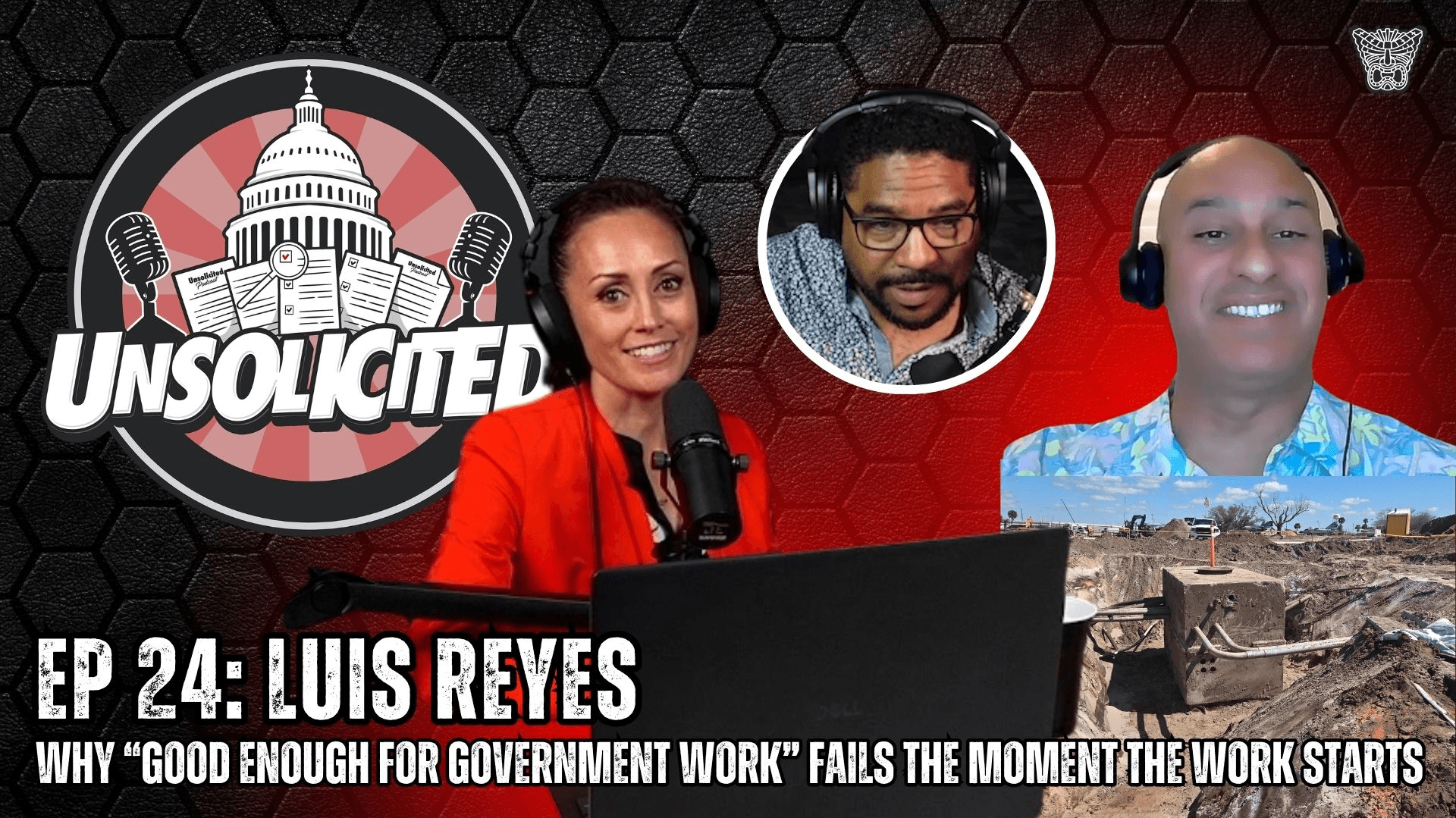
In this episode of Unsolicited, Hope Skibitsky sits down with Luis Reyes to unpack a question that shows up across federal contracting, usually after the work is already underway:
How do you actually deliver quality on a contract, and how can you tell whether quality is truly built into the work or just being promised?
From the start of the conversation, Luis makes the core point clear:
Quality is not something you do at the end. You do it throughout the whole process.
That idea drives this entire episode.
Drawing on his experience as an IT Project Manager and Site Lead supporting the 325th Communications Squadron Support Services (CSSS) contract at Tyndall Air Force Base, Luis explains why quality is not just about whether the final product works. It is about whether the work was planned, checked, documented, and executed in a way that reduces risk before the customer ever feels the problem.
This episode gets specific about what quality really looks like during execution:
- Why quality is a discipline, not a final inspection
- How hidden defects become customer problems later
- Why buried infrastructure changes the way verification has to happen
- What happens when teams assume they will catch problems later, but later is already too late
The conversation also tackles one of the more uncomfortable realities in contract delivery:
- Some quality problems are not technical problems first
- They are planning problems, oversight problems, documentation problems, or role design problems
- Work can look complete on paper and still carry risk in execution
- Capable people can still struggle when the structure around them creates overload
Luis walks through real examples that make that risk visible:
- Work that could not be cleanly rechecked once it was buried
- Situations where missed verification created downstream rework
- Why records, communication, and follow-through are part of quality, not just admin
- How customers end up absorbing the burden when quality is treated like an end-stage checkpoint
This is what makes the conversation bigger than one contract or one technical environment.
It becomes a practical discussion about what makes a contractor easier to trust, easier to manage, and easier to defend when questions come later.
The episode closes on what lower-risk, clearer-value delivery actually looks like:
- Quality built into the work, not inspected in later
- Visible process discipline
- Documentation that makes the work understandable and defensible
- Leadership and oversight structures that do not quietly create risk
- Teams that reduce burden instead of adding to it
And a principle that sits underneath the whole episode:
If quality is not being protected while the work is happening, it is probably already being lost.
What You’ll Learn:
- Why quality should be treated as a process, not a checkpoint
- How hidden execution gaps become customer risk later
- Why verification timing matters more than teams admit
- How role overload and weak oversight structures affect delivery quality
- Why documentation is part of quality, not separate from it
- What acquisition professionals should look for when evaluating delivery credibility
- How to tell whether a contractor has built quality into the work or is just claiming it
About Our Guest
Luis Reyes previously served as the IT Project Manager and Site Lead supporting the 325th Communications Squadron Support Services contract at Tyndall Air Force Base. Before entering that contractor role, he served on active duty at Tyndall as Chief Master Sgt., superintendent for the 325th Mission Support Group, where he was known for mentorship, leadership presence, and developing resilient Airmen. His background spans both military leadership and hands-on delivery, which gives him a grounded perspective on how quality is built into the work, how accountability shows up during execution, and what makes a contractor easier to trust when the pressure is real.
Connect with Luis on LinkedIn: https://www.linkedin.com/in/lrreyes/
Like, subscribe, and turn on notifications on YouTube for more Unsolicited conversations about execution, risk, and what actually makes a contractor the least risky and clearest value choice.
https://www.youtube.com/@NTI-GovCon
Follow us on LinkedIn: https://www.linkedin.com/company/namauu/
cd ../blog
EP 24: Luis Reyes – Why “Good Enough for Government Work” Fails the Moment the Work Starts
Alex Longoria-Mendoza

Podcast
Unsolicited
Real conversations about government contracting, no scripts, no fluff.