Innovation is everywhere in government language.
Modernization. Future-proofing. Emerging technology. Smarter systems.
But when it comes time to actually buy those solutions, the acquisition process often favors what is familiar, proven, and already inside the system.
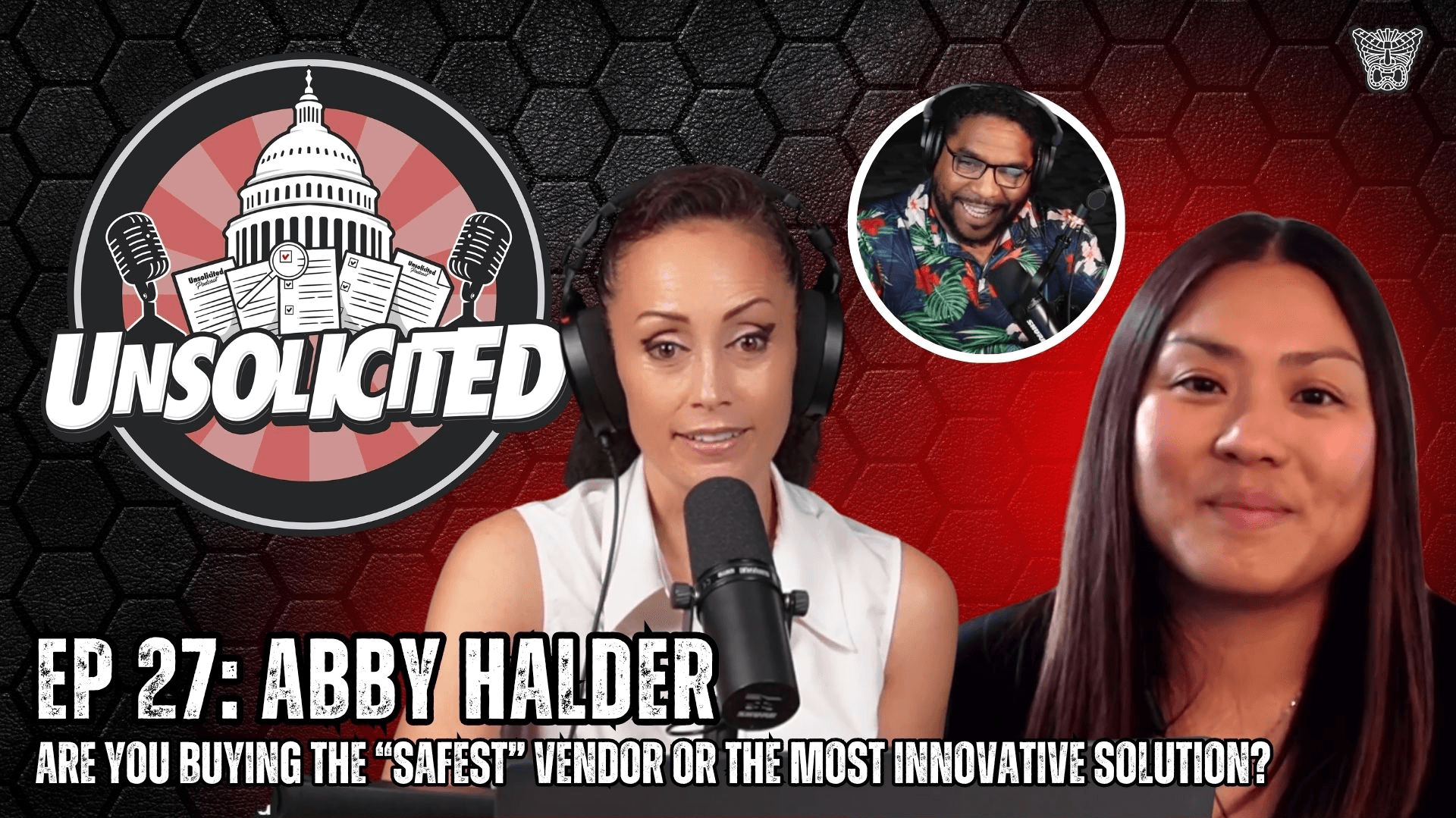
In this episode of Unsolicited, host Hope Skibitsky sits down with Abby Halder, CEO and Founder of The D.H. Collective, to unpack a tension that shows up across public sector acquisition:
*Why do agencies say they want innovation while still buying in ways that make it hard for newer solutions and newer vendors to even get in the room?*
Abby brings a practical perspective from the intersection of government contracting, capture, public sector IT, cybersecurity, cloud, proposals, and emerging technology growth. Her work with newer and more innovative companies gives her a clear view into the gap between what government says it wants and what procurement structures actually allow.
This conversation is not about ignoring compliance.
It is about asking whether acquisition teams sometimes apply the rules more narrowly than necessary, and whether “safe” choices on paper always create the best mission outcomes.
In this episode, we discuss:
- Why traditional past performance requirements can screen out innovative vendors too early
- The difference between a vendor that feels safe and a solution that is actually best suited for the mission
- How acquisition teams can structure solicitations differently without creating unnecessary risk
- Why individual experience, subcontractor past performance, and teaming history may matter more than company age alone
- The hidden cost of shutting innovation out before it can compete
- Why federal system integrators, primes, and larger partners may play a major role in helping newer solutions reach government customers
- What acquisition professionals can do when they genuinely want innovation but still have to operate inside compliance boundaries
This episode quietly answers:
How do acquisition professionals make room for better ideas without creating unnecessary risk or stepping outside the rules?
Learn more about Abby Halder and The D.H. Collective:
- Website: https://www.dh-collective.com/
- About Abby: https://www.dh-collective.com/about-us
- Contact The D.H. Collective: info@dhcollective.ai
- Connect with Abby on LinkedIn: https://www.linkedin.com/in/abigail-halder-79b5ba14/
Sources referenced in this episode:
- FAR 15.305, Proposal Evaluation
https://www.acquisition.gov/far/15.305
- FAR 11.002, Policy
https://www.acquisition.gov/far/11.002
- 13 CFR § 125.11, Past Performance Ratings for Certain Small Business Concerns
https://www.ecfr.gov/current/title-13/chapter-I/part-125/section-125.11
If you liked this episode, check out our conversation with Jeremie Wilson https://youtube.com/live/zgyvDcJGUVk?feature=share on what real capability looks like in federal operations. That episode pushes on a similar question from a different angle: how government teams can tell who is actually built to deliver, not just built to qualify.
For more real, raw, and unsolicited conversations about government contracting, acquisition, execution, and risk, make sure to like, subscribe, and turn on notifications.
Sometimes the barrier to better outcomes is not a lack of solutions.
It's the way we decide who gets seen in the first place.
cd ../blog
EP 27: Abby Halder – Are You Buying the “Safest” Vendor or the Most Innovative Solution?
Alex Longoria-Mendoza
Podcast
Unsolicited
Real conversations about government contracting, no scripts, no fluff.