A service contract can look straightforward on paper.
The work is defined. The labor categories are listed. The wage determination is attached. The price gets built, submitted, and awarded.
Then performance begins.
That is when the details start mattering more than people expected.
Was the right labor category used?
Were the actual duties matched correctly?
Did the team understand the difference between wages and fringe?
Was health and welfare priced correctly?
And when a new rate came out, did anyone know whether it changed the contract yet?
For federal service contractors, SCA is not just a compliance acronym. It is one of the places where pricing, payroll, performance, and audit exposure all meet.
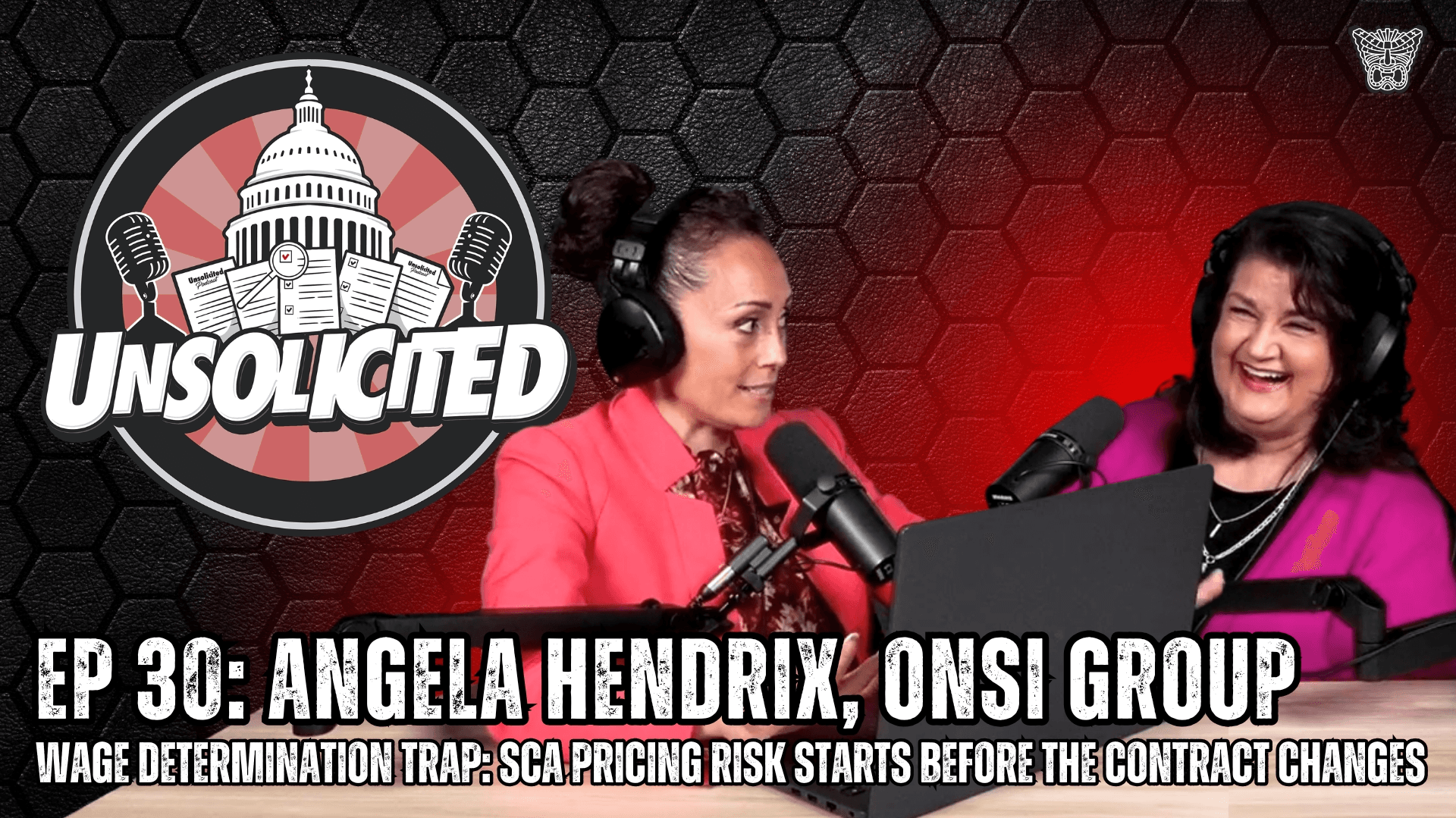
In this episode of Unsolicited, host Hope Skibitsky sits down with Angela Hendrix, Founder and President of The Onsi Group, Inc., to break down the Service Contract Act in a way that is practical for the people who have to price, manage, and defend federal service work.
Angela brings years of experience helping government contractors understand prevailing wage obligations, fringe benefit requirements, health and welfare administration, compliance audits, and the real business consequences of getting SCA wrong.
This conversation is not legal advice.
It is a practical risk conversation for contractors, pricing teams, capture teams, HR, payroll, contracts, BD, and acquisition professionals who need to understand how labor compliance decisions become cost and performance decisions.
In this episode, we discuss:
How to think about SCA before treating it like a checkbox
- Why a missing or unfamiliar labor category does not make the requirement disappear
- How actual duties can matter more than the job title written into the proposal
- Where contractors can underprice work without realizing the risk they are taking on
- Why fringe benefits and health and welfare need to be understood separately from base wages
- What can go wrong when teams react to a published update before checking the contract
- How option years and modifications can change the timing of SCA obligations
- Why price adjustment requests need a clear record of what changed and why
- How poor SCA assumptions can turn into payroll, compliance, audit, and performance problems
- What acquisition professionals can listen for when a contractor’s labor price looks low but not necessarily realistic
This episode quietly answers:
Are we pricing the service work clearly enough to defend the labor obligations behind it?
Learn more about Angela Hendrix and The Onsi Group:
- The Onsi Group website: https://www.theonsigroup.com/
- Angela Hendrix LinkedIn: https://www.linkedin.com/in/angela-hendrix-01174010/
Sources referenced in this episode:
- DOL: McNamara-O’Hara Service Contract Act Overview
https://www.dol.gov/agencies/whd/government-contracts/service-contracts
- FAR 52.222-41, Service Contract Labor Standards
https://www.acquisition.gov/far/52.222-41
- DOL: SCA Wage Determinations
https://www.dol.gov/agencies/whd/government-contracts/prevailing-wage-resource-book/sca-wage-determinations
- SAM.gov Wage Determinations
https://sam.gov/wage-determinations
- DOL: SCA Compliance Principles
https://www.dol.gov/agencies/whd/government-contracts/prevailing-wage-resource-book/sca-compliance-principles
- SAM.gov All Agency Memorandums
https://sam.gov/wage-determinations/resources/all-agency-memos
- DOL All Agency Memorandum No. 250
https://www.dol.gov/sites/dolgov/files/WHD/AAM/AAM250.pdf
- FAR 52.222-43, Fair Labor Standards Act and Service Contract Labor Standards, Price Adjustment
https://www.acquisition.gov/far/52.222-43
If you liked this episode, check out our conversation with Tom Prokop on what happens when GovCon companies try to grow through heroic effort instead of repeatable systems, and why weak pricing discipline, reactive business development, and unclear internal processes can create problems that show up after award.
For more real, raw, and unsolicited conversations about government contracting, acquisition, execution, pricing, and risk, make sure to like, subscribe, and turn on notifications.
A low labor price can look competitive at award.
But if the SCA assumptions underneath it are wrong, the cost usually shows up later.